The Group Chat Vote: 80% Want Christmas at Ours
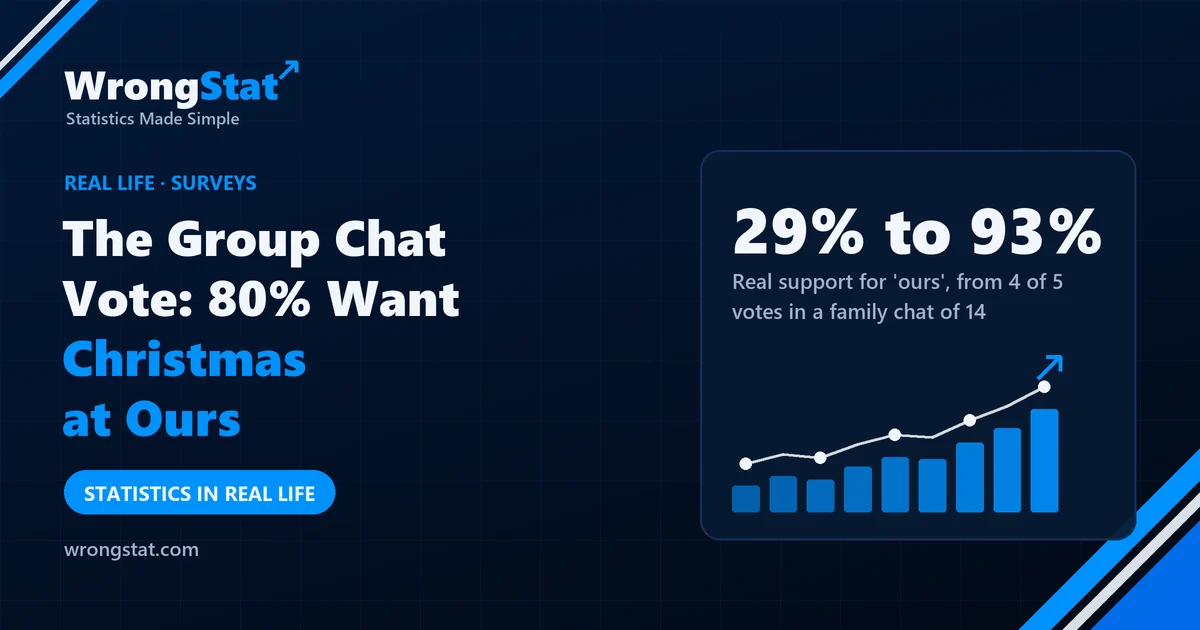
The short version: 4 of the 5 people who voted is 80%, but the family chat has 14 members. Count the 9 silent ones as all no, then all yes, and real support is anywhere from 29% to 93%. The people who answer first are rarely typical, rules for counting silence invented after the vote always favour whoever invents them, and the only real fix is to ask the people who didn't answer.
On the first of December, Aunt Linda posted a poll in the family group chat. Fourteen members. One question: "Christmas this year: ours as usual, or Kevin's new place?"
Within an hour, five people had voted. Four for "ours", one for "Kevin's". The one was Kevin. Grandpa Frank voted for "ours", as he votes for the first option of every poll, on principle, without opening it.
Uncle Gary announced the result before the hour was up: "80%. The family has spoken." Then he went to the garage to measure the big table.
80% of whom?
The family has fourteen members. Five spoke. Nine said nothing, which in a family group chat is the most common position on any subject.
- Voted: 5 of 14, a response rate of 36%.
- For "ours": 4 of the 5 who answered. That's where the 80% comes from.
- If all nine silent members wanted Kevin's, real support for "ours" would be 4 of 14: 29%.
- If all nine wanted "ours", it would be 13 of 14: 93%.
So the honest result of Linda's poll is that somewhere between 29% and 93% of the family want Christmas at Gary and Linda's. That's not a result. It's a range wide enough to park a camper van in.
This range isn't a margin of error. A margin of error is about bad luck in who you happened to pick at random. Here nobody was picked at random: people picked themselves. No amount of maths shrinks this range. Only the nine silent people can.
14 family members, one poll
What the poll can really say
Silence isn't random
If the nine were silent for random reasons, the five who answered might still look like the family. They don't. Who answers a group chat within an hour on a Tuesday? The retired members, who live ten minutes from Gary and have spent every Christmas at his table since 1994. Who doesn't? Aunt Linda's sister's family: two small children, a three-hour drive to Gary's and a forty-minute drive to Kevin's. They saw the poll at 11 p.m., while removing glitter from the dog.
When the people who don't answer are different from the people who do, it's called non-response bias. It's the same trap as the office survey that found 94% of staff happy. Silence carries information, and the information is usually "not what you hoped".
Three rules for counting silence
The family then spent two days deciding how to count the people who hadn't voted. Three rules were proposed.
Gary's rule: no answer means yes to the usual. Silence is consent. That's how it has always worked, and it has always worked.
Kevin's rule: no answer means they're busy, which means they're tired, which means they want the shorter drive, which means Kevin's.
Linda's rule: no answer means they don't care, so they don't count. This one was popular with everyone who had voted.
Each rule sounded reasonable. Each was proposed after the vote. Each produced exactly the winner its author wanted. A counting rule invented after you've seen the votes isn't a rule. It's a result wearing a rule's coat.
What Linda did next
Linda did the one thing survey statisticians actually recommend: she chased the silent ones. She messaged each of the nine privately. One question, no poll, no audience. Seven replied within two days.
| Ours | Kevin's | No answer | |
|---|---|---|---|
| First hour in the group chat | 4 | 1 | 9 |
| After Linda asked privately | 1 | 6 | 2 |
| The whole family | 5 | 7 | 2 |
The "80%" side now had 5 votes. Kevin's had 7. Two people still haven't answered anything, ever. If both chose "ours", it would be 7 against 7, and Christmas would be decided by the only two members of the family who have never once read the group chat.
How to run a family poll that means something
1. Report the response rate with the result. "4 of the 5 who answered, out of 14" is honest. "80%" on its own is a campaign slogan.
2. Work out the worst case. Count the silent ones as all yes, then as all no. If the answer flips, you don't have an answer yet.
3. Chase the silent ones. A quiet private question to the people who didn't answer is worth more than a louder poll to the people who did.
4. Agree how to count before you vote. Afterwards, every rule is a campaign.
Where it costs you money
"92% of our customers would recommend us" usually means 92% of the customers who answered the email, and those are mostly the happy regulars. The customers who left don't open the email. Before you believe a percentage, ask Linda's two questions: percent of whom, and how many were asked? A fund, an app or a course that can't tell you its response rate is telling you about the people who stayed.
The moral
Christmas was held at Gary and Linda's. Not because of the vote, but because on the second of December Gary had already bought a 22-pound turkey, which does not fit in Kevin's oven. That's a different statistical mistake, and Gary has form: see his camper van.
Next year Linda will post the poll at 9 p.m., when the young families are awake. Gary has proposed that the poll close at 8:30.
The family, the poll and its numbers are an illustration. Counting all non-responders one way and then the other is a standard, honest way to show how much missing answers could change a result. Educational content, not financial advice.