Does the Placebo Effect Actually Work? Why the $2.50 Sugar Pill Beat the 10-Cent One
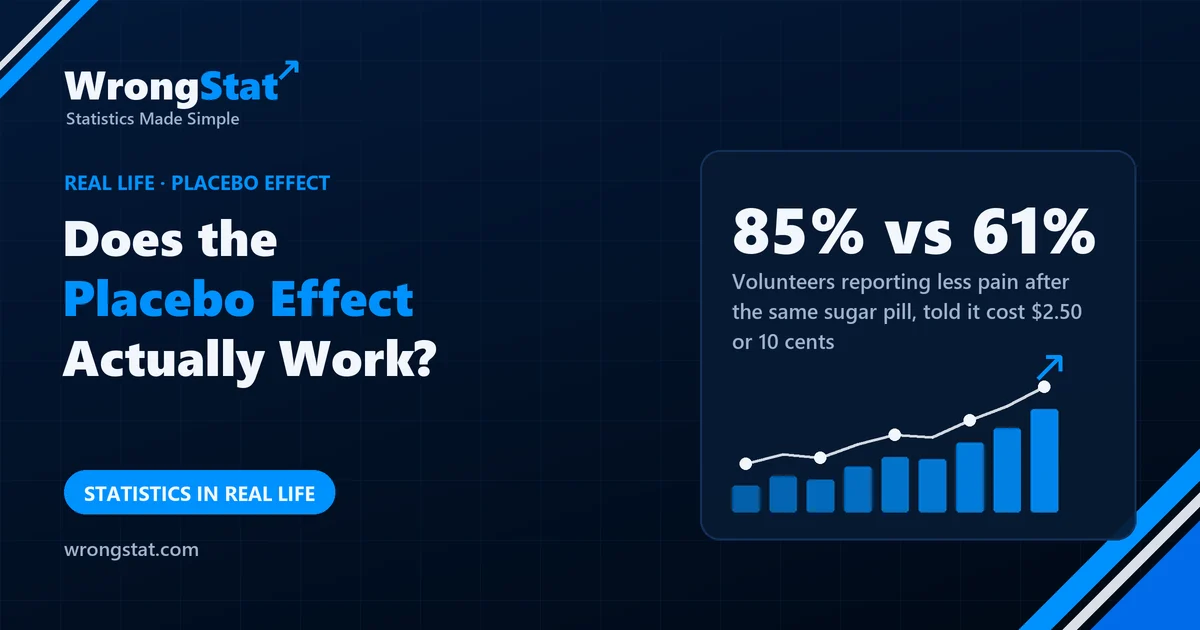
The short version: the placebo effect is real but narrower than its reputation. In a 2008 study, 82 volunteers received mild electric shocks before and after taking a sugar pill; 85% reported less pain when told the pill cost $2.50, and 61% when told it cost 10 cents. A 2001 review of 114 trials comparing placebo with no treatment found small effects on things people report themselves, such as pain, and no clear effect on things measured objectively. Part of what looks like a placebo effect is simply regression to the mean: people start treatment when they feel worst.
Uncle Gary's feet hurt, so he bought insoles. Not any insoles: "biomechanically engineered performance insoles" for $89, in a box with a diagram of a foot that looked like a jet engine. Aunt Linda's feet also hurt. She bought a $9 pair at the pharmacy, in a bag.
A week later, both of them say their feet feel better. Gary says his feel considerably more better, because his insoles have "zones". Linda asked what the zones do. Gary said they work on the zones. When Linda pointed out that her feet had stopped hurting too, Gary explained that hers had stopped hurting in a cheaper way.
The $2.50 sugar pill
Gary is not alone. In 2008, researchers published a small experiment in JAMA. They gave 82 healthy volunteers mild electric shocks, then a pill described as a new painkiller similar to codeine, then the shocks again. The pill was a placebo. The only difference was the leaflet:
- Half were told the pill cost $2.50. Of these, 85% reported less pain after taking it.
- Half were told it had been discounted to 10 cents. Of these, 61% reported less pain.
Same pill, same shocks, a 24 percentage point difference. Price is information, and people use it to decide how well something should work, then notice it working. This is the same mechanism that makes expensive wine taste better when you can see the label.
Volunteers reporting less pain after the same sugar pill
What the placebo effect is, and what it isn't
The placebo effect is improvement that comes from believing you're being treated, not from the treatment itself. It's why fair trials give one group the real thing and another group an identical dummy, without either knowing which is which. But "the placebo group got better" doesn't mean belief did all the work. Several things look identical from the outside:
- Natural course. Many aches get better on their own within days or weeks.
- Regression to the mean. People buy insoles, or join trials, on their worst days. From the worst day, the next day is usually better, whatever you do.
- Reporting. People who've paid $89 want to have chosen well, and answer "how are your feet?" accordingly.
To separate belief from all that, you need a third group that gets nothing at all. In 2001, two Danish researchers pooled 114 trials that had exactly that: placebo against no treatment. They found a small effect on outcomes people report themselves, such as pain (about 6.5 points on a 100-point scale), and no clear effect on outcomes measured objectively. They also noticed that smaller trials tended to show bigger effects, a classic warning sign. Other researchers have argued that the review was too sweeping. Nobody serious argues that a sugar pill shrinks tumours.
How to read a "placebo works" headline
1. Compared with what? Placebo against a real treatment tells you whether the treatment works. Placebo against nothing tells you about the placebo. Most headlines mix them up.
2. Felt or measured? "Less pain", "more energy" and "better sleep" are reported by the person. Blood pressure, X-rays and blood tests are measured. Placebo effects live mostly in the first group.
3. How many people? 82 volunteers is a useful demonstration, not a law of nature. A sample that small can show a large difference by luck, which is why one study is never the final word.
Where it costs you money
Fees work like the price on the leaflet. A fund that costs 2% a year feels more serious than one that costs 0.05%, and its owners tend to describe it more warmly. The fair test is the same as in medicine: compare results after costs, over the same period, with a cheap alternative such as an index fund, and look at measured returns rather than how confident everyone feels. Feeling better about an investment and the investment doing better are different outcomes.
The moral
Mia suggested a blind trial: swap the insoles without telling anyone. Gary wore Linda's $9 pair for a week and reported "a noticeable improvement in the zones". When told, he said that this proved the zones had transferred. Linda has kept the $89 pair. She uses them in her gardening boots, where, she says, they work exactly as well as the old ones, and look more impressive to the neighbours.
The insoles are fictional. Study figures are from Waber et al. (JAMA, 2008) and Hróbjartsson and Gøtzsche (New England Journal of Medicine, 2001). This is not medical advice: do not stop or swap any treatment without talking to a doctor. Educational content, not financial advice.