Myth #18 · Options expiration
Is Options Expiration Friday Bad for Stocks? We Tested 201 Third Fridays.
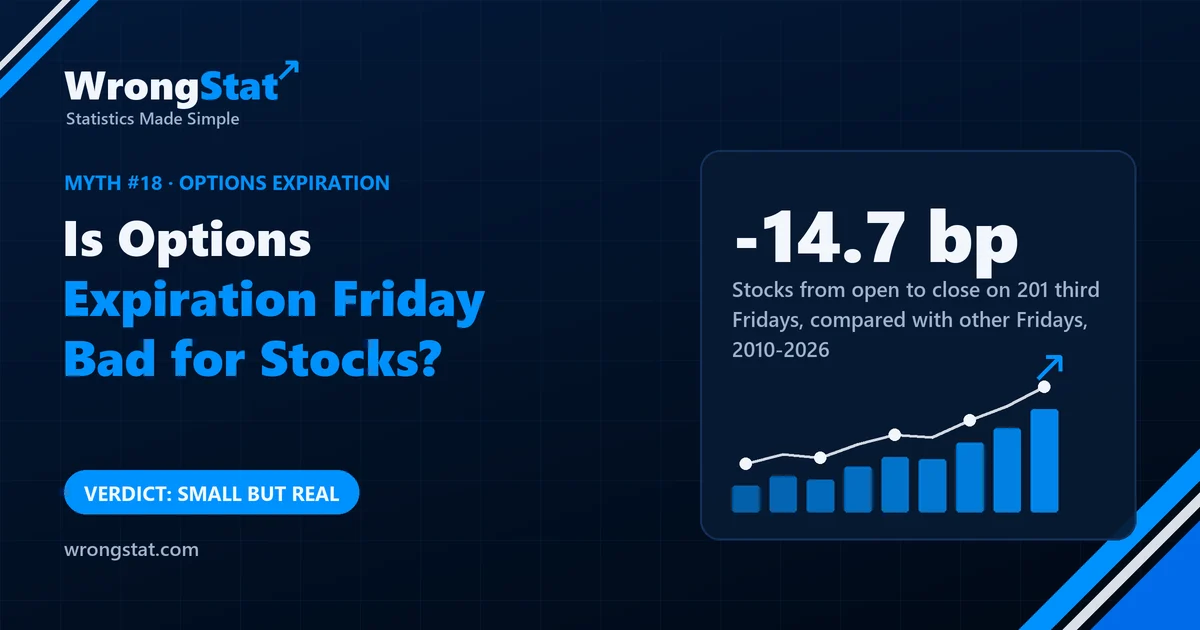
Verdict: a small dent, not a strategy. Across 201 third Fridays from 2010 to 2026, US stocks did about 15 basis points worse from open to close than on other Fridays (p = 0.026), with the same sign in both halves of the data. The overnight rise before expiration, the part the idea usually promises, wasn't distinguishable from chance, and trading it earned about 2.5 basis points after costs, 12 times a year. The 'day after a holiday' pattern didn't show up at all.
Uncle Gary has circled the third Friday of every month on the kitchen calendar. "Options expiry," he says darkly. "The big players push the market around. Never buy on a third Friday." Last month he moved his dentist appointment so he could watch the market not do anything in particular.
Aunt Linda asks how big the push is. Gary says it's big. We measured it.
What we tested
- Third Fridays: the day monthly US stock options expire. 201 of them from 2010 to 2026.
- Two parts of the day: overnight (Thursday's close to Friday's open) and the trading session (Friday's open to its close). The idea usually claims stocks rise into expiration and then reverse.
- What we measured: an equal-weighted basket of 571 US stocks, and the S&P 500.
- The comparison: all the other Fridays. Then the same check for a second calendar idea, the day after a US market holiday, compared with all other days.
The result
| Third Friday vs other Fridays, 2010-2026 | Third Friday | Other Fridays | Gap |
|---|---|---|---|
| Overnight (Thursday close to Friday open) | +7.5 bp | +3.9 bp | +3.7 bp (p = 0.42) |
| Trading session (open to close) | -7.2 bp | +7.4 bp | -14.7 bp (p = 0.026) |
| S&P 500, trading session | -15.0 bp (p = 0.026) |
A basis point (bp) is a hundredth of a per cent. The session dip is real in the statistical sense: it showed up in the basket and in the index, and with the same sign in both halves of the data (-9.5 and -5.9). The overnight rise that the idea is usually built on was small and well within chance. Trading only that overnight move would have made about 7.5 basis points a time, or 2.5 after costs, with 55% of trades winning, about 12 times a year.
So Gary is a little bit right. Buying at the open on a third Friday has, on average, been about 0.15% worse than buying at the open on another Friday. That's twelve days a year, a fraction of a per cent each time. It's a fact about the calendar, not a reason to move a dentist appointment.
Third Friday vs other Fridays, 571 US stocks, 2010-2026
The day after a holiday
We tested a second calendar idea at the same time: stocks supposedly start weak the day after a market holiday. Across 148 such days, every comparison went slightly in that direction (session -2.7 vs +3.2 bp, overnight -0.6 vs +4.2, whole day -3.3 vs +7.5), but none was significant (p between 0.21 and 0.44), and the direction changed between the two halves of the data. That one is a myth.
Statistics for noobs: significant and small
A p-value of 0.026 says a dip this size would be unusual if third Fridays were ordinary. It doesn't say the dip is big. Always look at the size too, in money: here about 0.15% on 12 days a year. Something can be statistically real and practically almost irrelevant.
And remember the second idea we tested. Two calendar ideas, one hit: with enough calendar ideas, some will pass by luck. This one passing in both halves of the data makes luck less likely, not impossible.
The moral
Gary's circle on the calendar marks a real but tiny dent. His dentist appointment cost more. Linda has suggested that if he must avoid something on third Fridays, he could avoid checking the market, which would save the same 0.15% of his attention and all of his mood.
Every test on this site is judged against a sensible comparison. Here it was other Fridays, and third Fridays were a little worse, by an amount too small to trade on after costs.
What this test can't tell you
- Daily data only. The original idea is mostly about the futures market overnight, minute by minute. We used daily stock prices.
- The effect may be fading. The person who popularised the idea has also noted that it weakened after it was published.
- US stocks listed today, which brings survivorship bias.
- Absence of evidence. No significant post-holiday effect in our test isn't proof that none exists.
Statistical tests on historical data, not real trades. Daily prices of the S&P 500 and 571 US stocks listed today, 2010 to 2026; trading example with 0.05% costs per round trip. Historical results do not guarantee future returns. This is educational content, not financial advice.