What 99.9% Uptime Really Means: Hours, Not Decimals
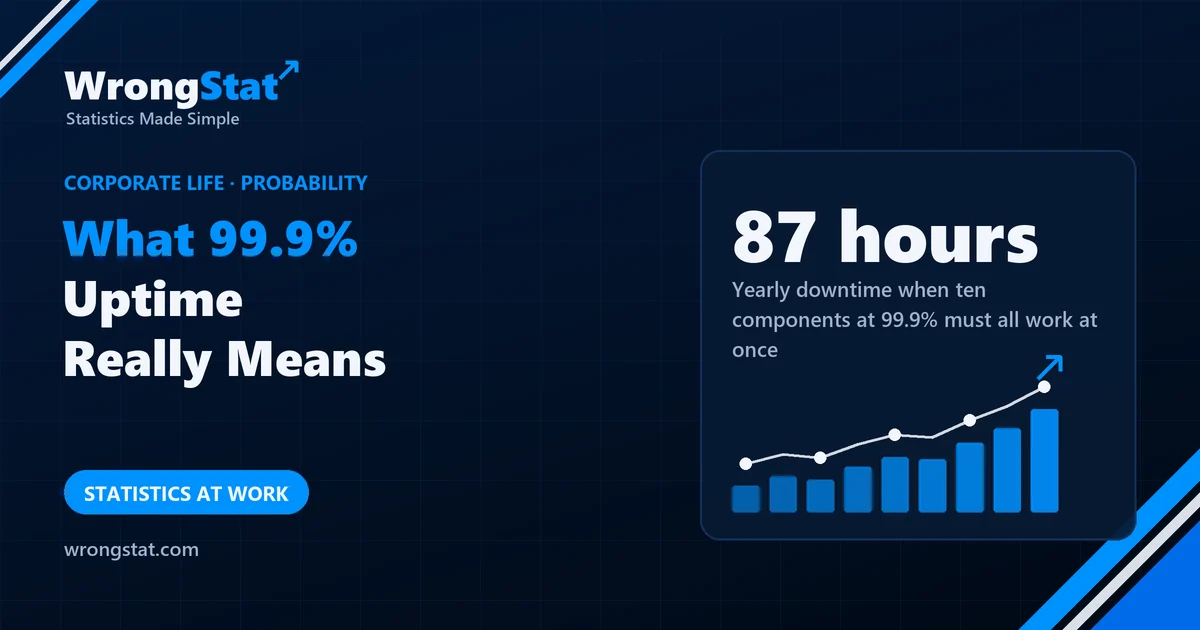
The short version: percentages close to 100 hide the part that matters. 99% availability allows 87.6 hours of downtime a year, 99.9% allows 8.8 hours and 99.99% about 53 minutes. When a service needs several components to all be working, their availabilities multiply: ten independent components at 99.9% each give 99.0% for the whole, about 87 hours down a year. Running two independent copies of a 99% component side by side gives 99.99%. Think in hours of downtime, and in what has to work at the same time.
The company is choosing a supplier for the new online ordering system. The winning bid promises 99.9% availability. The sales director is delighted: "So it's basically never down."
The system also depends on a payment provider, a login service, a stock database, a delivery tracker and the company's own network, each with its own 99.9%. Kevin starts doing some multiplication.
Turning nines into hours
A year has 8,760 hours. The useful number is the missing part: what's left after the availability.
| Availability | Downtime allowed per year | Per month |
|---|---|---|
| 99% | 87.6 hours | about 7 hours |
| 99.9% | 8.8 hours | 43 minutes |
| 99.99% | 53 minutes | 4 minutes |
Each extra nine cuts downtime tenfold. Going from 99% to 99.9% sounds like a rounding difference; it's the difference between three and a half days a year and one long evening.
When everything has to work
The ordering system only works when all its parts work. If their failures are independent, the chance that all are up at once is the product of their availabilities: the multiplication rule.
| Components in a chain, each 99.9% | Whole system | Downtime per year |
|---|---|---|
| 1 | 99.9% | 8.8 hours |
| 5 | 99.5% | 44 hours |
| 10 | 99.0% | 87 hours |
| 20 | 98.0% | 174 hours |
Each part is "basically never down". Together, they're down for more than three and a half days a year.
Yearly downtime of a chain of components, each 99.9% available
When either can work
The same rule works in reverse for backups. If two copies of a component run side by side and the system works when either is up, the system fails only when both fail at once. Two independent copies at 99% each fail together 1% of 1% of the time, giving 99.99%. That's why critical systems duplicate the weakest links.
The catch is the word independent events. Two copies in the same building, on the same power supply or running the same faulty update fail together, and the multiplication no longer helps.
Statistics for noobs: look at the complement
For anything close to 100%, flip it and look at the gap: 99.9% working is 0.1% failing, and 0.1% of a year is 8.8 hours. The same trick works for reliability, pass rates and accuracy. "99% accurate" on a million checks is 10,000 mistakes.
Where it costs you money
A plan that needs five things to go right, each "very likely" at 90%, has only a 59% chance of all of them happening. Investment cases that chain several hopeful assumptions are much weaker than any single assumption looks.
The moral
Kevin presented the chain: the ordering system plus the five things it depends on, six links at 99.9%, add up to about 52 hours of expected downtime a year. The sales director asked whether a single supplier offering 99.99% would solve it. Kevin said yes, if it also ran the payments, logins, stock, delivery and network. The supplier offered to do all of it, at 99.9%.
What this can't tell you
- Failures aren't always independent. Shared networks, data centres and updates make components fail together, which can make a chain better or a backup worse than the simple rule says.
- Not all downtime is equal. Eight hours at 3 a.m. on a Sunday and eight hours on the busiest day of the year cost very different amounts.
- Promises aren't measurements. A contract's 99.9% is a target with penalties, not a guarantee of what happens.
The ordering system and the suppliers are an illustration. The figures are straightforward calculations from the availability percentages, assuming independent failures. Educational content, not technical, business or financial advice.