Sales Up 300%? Check the Starting Number
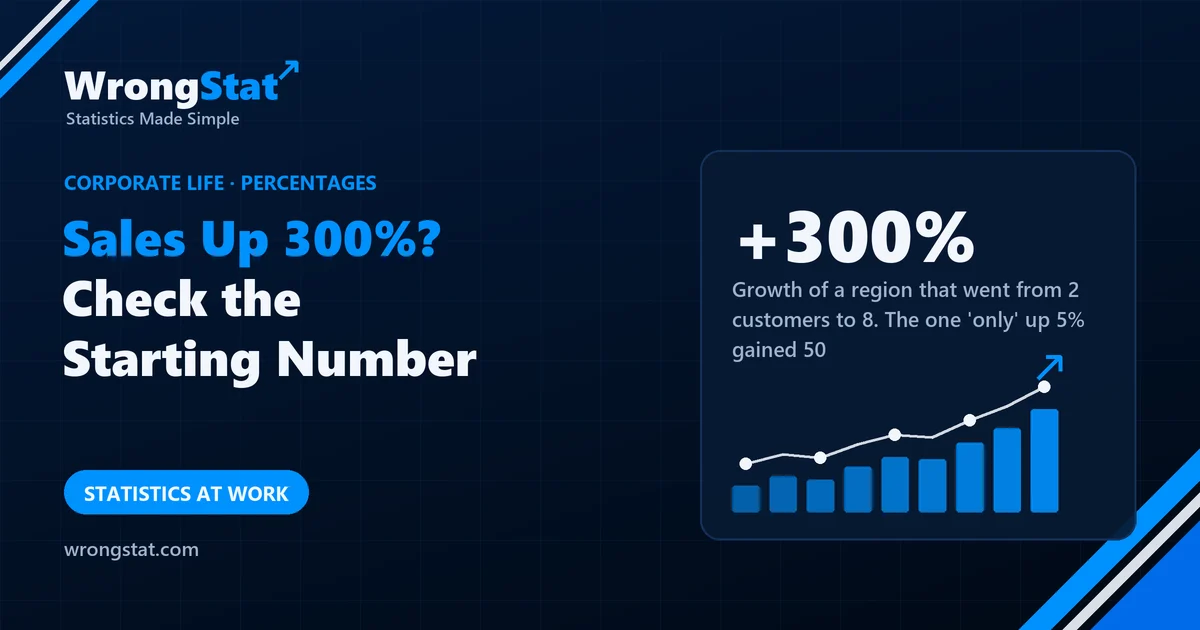
The short version: a percentage change is only as meaningful as its starting number. Going from 2 customers to 8 is +300%; going from 1,000 to 1,050 is +5%, but adds 50 customers instead of 6. Small bases produce huge percentages, in both directions, from a handful of events. A related trap: a conversion rate rising from 2% to 3% is up 50% and up one percentage point, and reports pick whichever sounds better. Always ask for the starting number and the absolute change.
Annual awards. "Fastest-Growing Region: the North-East, up 300%!" Applause. The old South region, up 5%, is mentioned later under "areas for improvement".
Kevin looks at the appendix. The North-East went from 2 customers to 8. The South went from 1,000 to 1,050.
The base effect
| Last year | This year | Change | New customers | |
|---|---|---|---|---|
| North-East | 2 | 8 | +300% | 6 |
| South | 1,000 | 1,050 | +5% | 50 |
A percent change divides the change by the starting value. When the starting value is tiny, a few events make an enormous percentage. That's the base effect: the size of the base, not the performance, drives the number. Next year, if the North-East loses 4 customers, it's down 50%, and the region with the "worst decline" may still be the one that grew the most in absolute terms.
Percent or percentage points?
A second trap lives in rates. The website's conversion rate rose from 2% to 3%. Is that up 50% or up 1%? Both, depending on how you measure:
- Up 1 percentage point: the plain difference between 2% and 3%.
- Up 50%: the relative change, 1 divided by 2.
Neither is wrong. Reports tend to pick the big one for good news and the small one for bad news. The honest version gives both, or at least says which.
The two numbers to ask for
- The starting number. "Up 300% from what?" A tiny base means the percentage is mostly noise.
- The absolute change. 6 customers or 50, 1 point or 10. That's what pays the bills.
Statistics for noobs: percentages need a denominator
A percentage is a fraction with its bottom hidden. When the bottom is small, the fraction swings wildly: one extra customer in a region of two is +50%; in a region of a thousand it's +0.1%. Whenever a percentage looks dramatic, uncover the denominator before reacting.
Where it costs you money
"This small company's profits rose 400%" can mean $100,000 became $500,000, and a share price that already rose tenfold. Growth from tiny bases is the most advertised and the least informative. Ask for the absolute numbers, and how stable they've been over several years.
The moral
The North-East manager received the Fastest-Growing Region trophy and a larger budget. The South manager asked whether 50 new customers counted for anything. The board agreed they did, and introduced a second award, Most Customers Gained. It went to the North-East next year, for growing from 8 to 20 customers, which the board noted was "an outstanding 150%".
What this example can't tell you
- Small bases can grow. A new region can be a real opportunity; the point is that its percentage doesn't prove it yet.
- Absolute numbers can mislead too. A big region adds more customers even when it's run badly. Compare like with like, ideally with several years.
- The figures are invented. They show the arithmetic, not any real company.
The awards, the regions and the trophies are an illustration. The figures are our own example. Educational content, not business or financial advice.