Corporate life · Murphy's laws
Why It's Always in the Last Place You Look
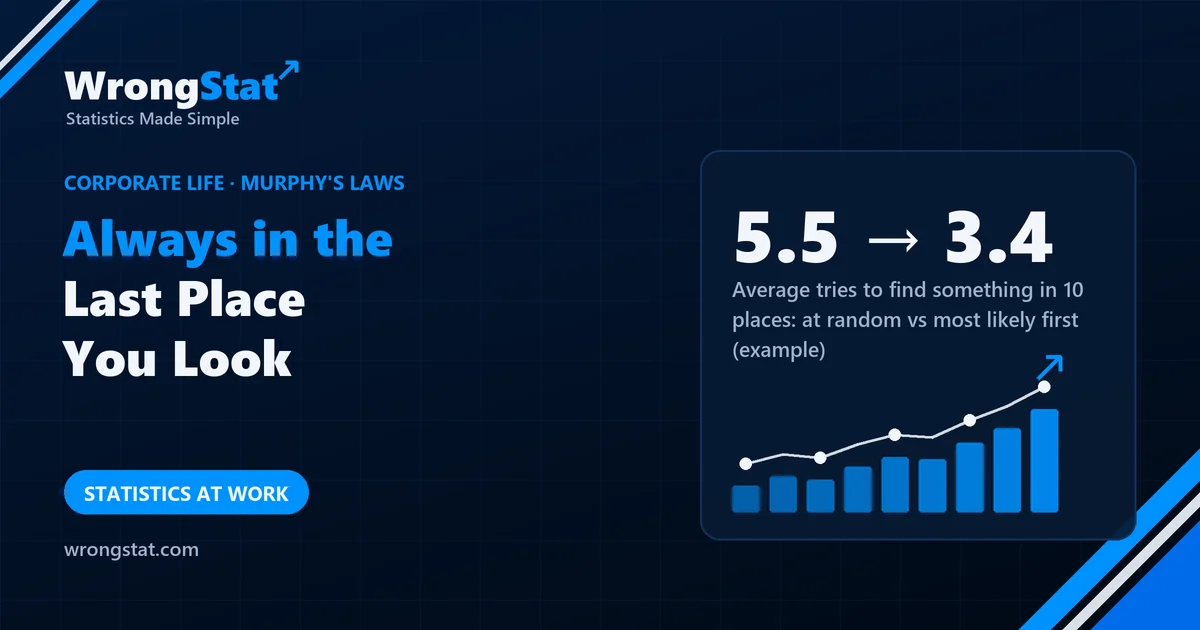
The short version: what you're looking for is always in the last place you look because you stop looking once you find it. That's a stopping rule, not a curse. The useful part is how long the search takes: checking 10 places in random order takes 5.5 looks on average; checking them from most to least likely takes about 3.4 in our example. Murphy's version feels true because memory keeps the long searches and forgets the quick ones.
The signed contract is needed for a meeting in ten minutes. Kevin checks the shared drive, his email, the "Final" folder, the "Final_v2" folder, the "Final_FINAL" folder and his desktop. It's in the last place he looks: a folder called "Misc", inside another folder called "Misc".
Darren, watching, says this always happens. Kevin agrees that it always happens, and points out why.
The law that can't be broken
"It's always in the last place you look" is one of Murphy's most reliable laws, because it's true by definition. You stop searching when you find the thing, so wherever you found it becomes the last place you looked. If you kept searching after finding it, it would no longer be the last place, and you'd be the only person in the office doing that.
A rule for when to stop that decides the result is a stopping rule, and it fools people in more serious places too: in experiments that stop as soon as the result looks good, the "result" is partly made by when you stopped. That's optional stopping.
The part that does matter: how many places first
The interesting question isn't where it ends up, but how many places you check before that. With 10 equally likely places checked in random order, the average is 5.5 looks. But places are rarely equally likely. Suppose, in our example, the first place is about three times as likely as the third, and so on down the list:
| How you search 10 places | Average number of looks |
|---|---|
| Random order | 5.5 |
| Most likely place first | 3.4 |
The expected value of the search drops by more than a third, just by ordering. Real searches (rescue teams, debugging, auditors) use the same idea: look first where the probability is highest and the look is cheapest.
Why it feels like a curse
A search that ends at the first place leaves no memory: you open the drawer, there's the stapler, nothing happened. A search that ends at the tenth place is a story. Memory keeps the stories, so the long searches feel typical. It's the same trick as the printer that "always" jams.
Statistics for noobs: check the stopping rule
When a result seems to "always" happen, ask whether the way you look makes it inevitable. Lost things are always in the last place, the bad meeting is always the one you remember, and the test that "worked" is often the one where someone stopped looking at the right moment.
Where it costs you money
A trader who keeps testing strategies until one works will always find that "the last one I tried" is the winner. The stopping rule made the result. A fair test fixes what will be tested before looking at the results.
The moral
Kevin made a proposal: the team would search in order of likelihood, starting with the folder that most often holds the answer. They agreed and checked the data: the most likely place was "Misc" inside "Misc". The folder has been renamed "Important". Nobody can find anything in it any more.
What this can't tell you
- Our probabilities are an example. The saving depends on how lopsided the real chances are; with equal chances, order doesn't help.
- Some places are cheaper to check. The best order weighs both how likely a place is and how long it takes to look.
- Sometimes it's nowhere. The law assumes you find it. Searches that end empty-handed are their own Murphy's law.
The contract, the folders and Darren are an illustration. The figures are our own calculation: 10 places, either equally likely and searched at random, or with chances proportional to 1, 1/2, 1/3 and so on, searched from the most likely. Educational content, not financial advice.