Corporate life · Murphy's laws
Little's Law: Why Starting Everything Makes Everything Slower
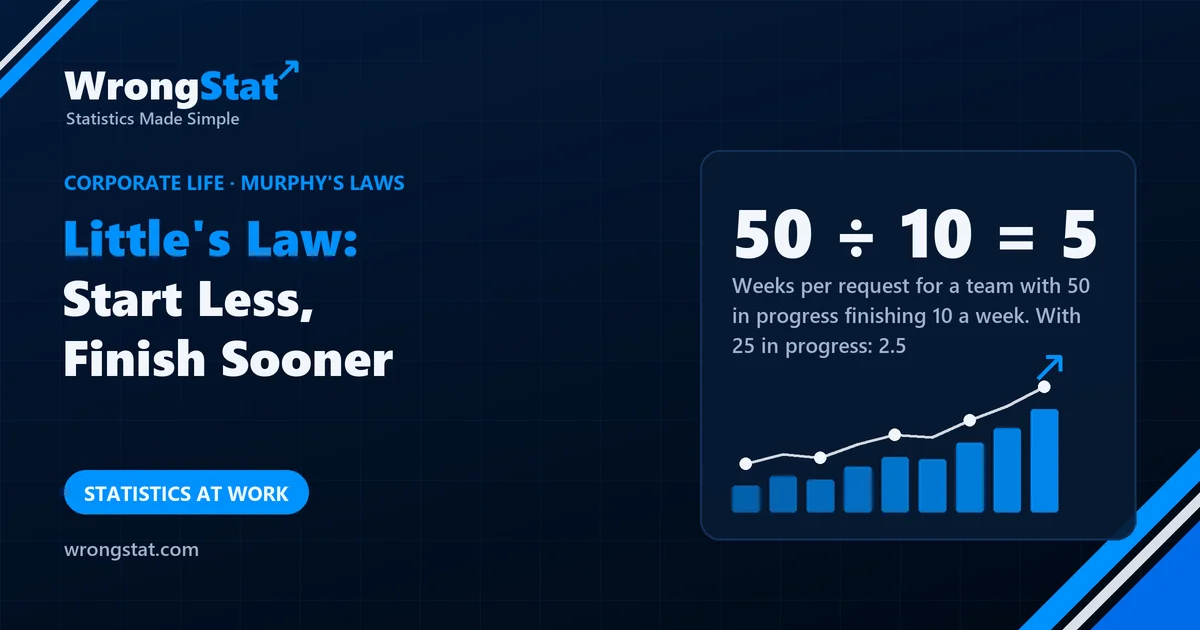
The short version: on average, the number of things in progress equals how many you finish per week times how many weeks each one takes. Rearranged: average time to finish = work in progress ÷ throughput. A team finishing 10 requests a week with 50 in progress takes 5 weeks per request on average; with 25 in progress and the same pace, 2.5 weeks. The rule, proved by John Little in 1961, holds for long-run averages whatever the mix of work. Starting more things doesn't raise throughput; it only lengthens the queue.
Kevin's team has a board with 50 sticky notes in the "In progress" column. Every one of them is, according to its owner, "nearly done". The team finishes about 10 a week. Customers complain that requests take forever.
The boss's response is to start more things in parallel, "to show momentum". The column now has 62 notes. Customers complain more.
The law
In 1961 an operations researcher, John Little, proved a formula that had been used informally for years. In plain words: the average number of items in a system equals the average rate at which they arrive (or leave) times the average time each one spends inside. Written as letters, L = λW, and rearranged for teams:
Average time to finish = work in progress ÷ items finished per week
The remarkable thing about Little's law is how little it assumes. It doesn't care whether tasks are big or small, regular or random. Over a long enough period, it simply holds, which makes it one of the few exact rules in management.
Kevin's board
| In progress | Finished per week | Average time per request |
|---|---|---|
| 62 | 10 | 6.2 weeks |
| 50 | 10 | 5 weeks |
| 25 | 10 | 2.5 weeks |
| 10 | 10 | 1 week |
The team's speed, 10 a week, is the same in every row. Only the amount of work started changes, and with it the wait. Starting more things doesn't finish more things. It just makes each thing wait longer behind the others.
Why "momentum" makes it worse
In practice, more work in progress usually lowers throughput too: people switch between tasks, forget where they were, chase status updates and sit in meetings about the 62 notes. So the wait grows twice: more items in the queue, and fewer coming out each week.
That's why many teams set a work-in-progress limit: nothing new starts until something finishes. It feels slower. By Little's law, it's faster.
Statistics for noobs: an identity about averages
Little's law is about long-run averages, not individual items: some requests will take a day, others three months. But the average is fixed by the two numbers you can see on the board. If you know any two of work in progress, throughput and time, you know the third.
Where it costs you money
A personal to-do list, a stack of half-read investment research or a portfolio of "positions I'll review later" all obey the same rule. The more you have open, the longer each one waits for attention, and some decisions go stale while they wait.
The moral
Kevin's team introduced a limit of 20 items in progress. Average time per request fell from five weeks to two. The boss was delighted and asked how many more items they could start now that they were so fast. Kevin explained Little's law again. The boss has asked for a separate board for "strategic work in progress", which has no limit.
What this can't tell you
- Long-run averages only. Over a week or two, especially after a big change, the numbers can be far from the formula.
- Throughput is the hard part. The law tells you the time once you know the pace; it doesn't make the team faster by itself.
- Units must match. Items per week and time in weeks, or items per day and time in days.
Kevin's board and the boss are an illustration. Little's law was proved by John D. C. Little in Operations Research (1961). The table is simple arithmetic from the law. Educational content, not business or financial advice.